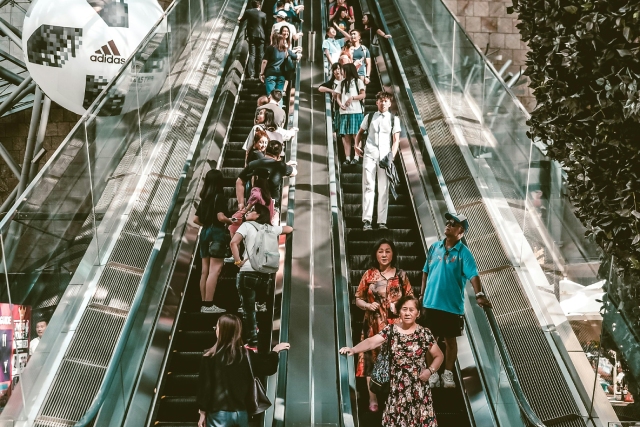
In the heart of Singapore’s Civic District, a stone’s throw from the neoclassical grandeur of the National Gallery and the high-tech, minimalist corridors of Funan mall, stands a building that feels like a portal to another world. For those who don’t know, Peninsula Plaza is a 1980s-era shopping complex that seems a bit weathered compared to its towering neighbors. But for the Burmese community in Singapore, it is the beating heart of their diaspora.
The transition from the street into the mall is immediate and apparent. The air changes, carrying the pungent, savory aroma of fermented shrimp paste and the earthy scent of toasted chickpea flour. The visual landscape shifts from English signage to the rounded, elegant script of the Burmese alphabet. On any given day, but especially on Sundays, the mall is a sea of thanaka-dusted cheeks and traditional longyis. This is “Little Myanmar,” a vertical village that provides a sense of continuity and home for a community thousands of miles away from the Irrawaddy.
The Architectural Roots (1979–1980)
Completed around 1980, Peninsula Plaza was developed by Consolidated Hotels Limited. At the time of its opening, it was considered a premier destination, featuring a 30-story office block and a five-story retail podium. Unlike the modern “curated” malls of today, Peninsula Plaza was designed with strata-titled units, meaning individual owners bought the shops.
This ownership structure is precisely what allowed the Burmese enclave to flourish. Because the units were individually owned, the mall could evolve organically based on market demand, rather than being strictly dictated by a central management’s “lifestyle” vision.
The Genesis: How the Enclave Formed
The transformation of Peninsula Plaza into a Burmese enclave began in earnest during the late 1980s and early 1990s. This period was marked by significant political and economic shifts in Myanmar, particularly following the 8888 Uprising in 1988, which saw an increase in Burmese nationals seeking education and employment opportunities abroad.
The “anchor” for this community was initially found in the maritime industry. For decades, Singapore has been a global hub for shipping, and Burmese sailors were a significant part of the merchant navy crews docking in the city-state. These sailors needed a central location to meet, exchange news, and purchase supplies. Peninsula Plaza’s proximity to the shipping agencies near the Singapore River and the ease of access via the City Hall MRT station made it the logical pit stop.
As these sailors returned home and shared stories of this specific mall, it became a landing pad of sorts for subsequent waves of migrants—students, healthcare workers, and domestic helpers. By the late 1990s, what started as a few travel agencies and import shops had ballooned into a full-scale ecosystem. The mall solved a critical problem for the diaspora: the iInformation gap. In an era before smartphones, the notice boards of Peninsula Plaza were the primary way to find roommates, job openings, or news from home.
The Pillars of Little Myanmar
To understand why the community is so fiercely loyal to this specific building, one must look at the specific services that keep the Little Myanmar engine running.
1. Culinary Comfort: The Taste of Belonging
Food is the strongest tether to home, and Peninsula Plaza offers flavors that are notoriously difficult to replicate in standard Singaporean hawker centers. In the basement food courts and tucked-away corners of the upper floors, you will find mohinga, the quintessential Burmese breakfast of rice noodles in a rich, ginger-and-lemongrass-infused catfish broth.
Perhaps more importantly, it is the only place in Singapore where you can reliably find lahpet thoke (fermented tea leaf salad). In Burmese culture, sharing tea leaves is a gesture of peace and social bonding. The small eateries in the mall serve as communal living rooms where people sit for hours, sipping free-flow green tea and catching up on gossip, effectively replicating the teashop culture that is central to life in Yangon or Mandalay.
2. The Economic Bridge: Remittances and Logistics
For many members of the community, particularly those working in the construction or domestic sectors, Peninsula Plaza is a logistical necessity. The mall houses numerous remittance agencies that facilitate the flow of money back to Myanmar. For years, this was often done through the Hundi system, which is a traditional, trust-based method of money transfer that operated alongside formal banking.
Beyond money, there is the parcel economy. On weekends, you will see massive cardboard boxes being taped up in the corridors. These are filled with everything from electronics to medicines and clothing, destined for families back home. The specialized courier services in the mall understand the unique customs regulations and logistics of shipping to Myanmar, providing a service that generic international couriers cannot match.
3. Cultural Identity: The Longyi and Thanaka
While many migrants adapt to local fashion, Peninsula Plaza is where the Burmese reclaim their visual identity. It is the primary source for longyis which is essentially the traditional sarong worn by both men and women. Shopfronts are draped in vibrant textiles featuring ethnic patterns from the Shan, Kachin, and Karen states. Furthermore, the mall is the go-to spot for thanaka, the yellowish-white cosmetic paste made from ground bark.
A Space for Solidarity
Peninsula Plaza serves as the community’s town square. This is most visible on Sundays, when thousands of Burmese domestic workers and laborers congregate on the mall’s perimeter.
It is also a site of political and social importance. During significant events in Myanmar, whether it be the annual Thingyan (Water Festival) or periods of domestic political unrest, the mall becomes a gathering point for news-sharing, fund-raising, and collective support.
Final Thoughts
Peninsula Plaza is a testament to the fact that a city’s spirit is rarely found in its newest, shiniest buildings. Instead, it is found in the in-between spaces where communities are allowed to take root. For the Burmese in Singapore, this mall is a sanctuary, a supermarket, a post office, and a town hall all rolled into one.
As long as there are longyis to be sold and mohinga to be shared, Peninsula Plaza will remain Little Myanmar—a vibrant, fragrant, and essential thread in the multicultural tapestry of Singapore.